Peer-reviewed science and references
Studies the Research Subcommittee considers most worth a manager’s time, grouped by focus area and listed newest first, each with a plain-language summary. For the complete literature collection, search the Publication archive. More guides and data are on the Resources page.
Searching the whole collection? Try the Publication archive → · Know a peer-reviewed study we’re missing? Suggest a study →
Management & control10 studies
Evaluating the effectiveness of trapping, toxicants, and other tools, from whole-sounder removal to coordinated, multi-agency operations.
-
2026
Wild pigs, wild costs: the economic consequences of wild pig invasions in the United StatesMcKee et al. Pest Management Science, 2026.
A national accounting that puts wild pig damage to agriculture, property, and natural resources at a minimum of $3.4 billion a year, and argues the true cost is higher for want of standardized damage data.
-
2026
The incident command system and invasive species controlCarlisle & Cross. Biological Invasions, 2026.
Field evidence that running wild pig elimination through a unified incident command system improved interagency coordination, accountability, and capacity.
-
2025
Strategies for wild pig control: Missouri’s progress toward eliminationCross & Carlisle. Wildlife Society Bulletin, 2025.
How Missouri became the first state to pursue statewide elimination, using systematic baiting, professional trappers, a central reporting hotline, and aerial operations.
-
2025
Evaluation of common trap types for capturing wild pigsTaylor, Buxton & Beasley. Wildlife Society Bulletin, 2025.
A four-state test of corral, drop, and passive net traps found all three can capture entire wild pig social groups when used well.
-
2023
Wild pig abundance, crop damage, and environmental impacts in response to control effortsTreichler et al. Pest Management Science, 2023.
Sustained, intensive control cut wild pig relative abundance by about 70% within 24 months and rooting damage by roughly 99%, direct evidence that coordinated removal works.
-
2023
Whole-sounder removal versus traditional control for reducing wild pig populationsKilgo et al. Pest Management Science, 2023.
Removing the entire family group in a single event reduced pig density far more than conventional trapping.
-
2018
Hunting as the main technique used to control wild pigs in BrazilRosa et al. Wildlife Society Bulletin, 2018.
A survey of wild pig control in Brazil found hunting is the dominant method, carried out mostly by volunteers and often outside legal channels.
-
2017
Effectiveness of a bounty program for reducing wild pig densitiesDitchkoff, Holtfreter & Williams. Wildlife Society Bulletin, 2017.
A bounty program failed to reduce wild pig numbers, with densities rising during the program, evidence that bounties are not an effective control tool.
-
2017
Hog Heaven? Challenges of managing introduced wild pigs in natural areasKeiter & Beasley. Natural Areas Journal, 2017.
A review of the impacts of wild pigs in natural areas, the traits that make them hard to remove, and what effective control and eradication require.
-
2014
Evaluation of continuous-catch doors for trapping wild pigsSmith et al. Wildlife Society Bulletin, 2014.
Continuous-catch trap doors let additional pigs enter after the door closes, improving whole-group capture in corral traps.
-
2004
A test of the Judas technique for eradicating feral pigsWilcox et al. Transactions of the Western Section of the Wildlife Society, 2004.
A field test of the Judas technique, using radio-collared pigs to locate the rest, to help eradicate a remnant wild pig population.
Damage & economics4 studies
Quantifying impacts to agriculture, natural resources, and infrastructure to inform funding and policy.
-
2025
Externalities in wild pig damages on U.S. crop and livestock farmsMcKee et al. PLOS ONE, 2025.
How a landowner’s actions and the surrounding landscape raise wild pig damage on neighboring farms, underscoring why control has to be coordinated across property lines.
-
2024
Resources safeguarded by preventing wild pig expansionJareb et al. Biology (Basel), 2024.
Analysis finding the national program safeguarded an estimated $40.2 billion in crops and pasture from 2014 to 2021.
-
2024
Economic impacts of wild pigs on producers of six cropsMcKee et al. Agriculture, 2024.
The first survey-based estimate of wild pig damage to producers of six row crops across eleven states, totaling roughly $700 million in a single year.
-
2023
Economic impacts of wild pigs on livestock producers in 13 statesMcKee et al. Human–Wildlife Interactions, 2023.
A 13-state survey quantifying what wild pigs cost livestock producers through pasture degradation, property and infrastructure damage, and lost forage.
Ecology & impacts on wildlife5 studies
Reproduction, movement, density, and habitat use, and the effects of wild pigs on native wildlife and habitats.
-
2024
Population response of eastern wild turkey to removal of wild pigsMcDonough et al. Journal of Wildlife Management, 2024.
After about 1,850 wild pigs were removed from Alabama sites, wild turkey abundance and occupancy rose, evidence that pig removal can locally benefit turkeys.
-
2020
Invasive wild pigs as primary nest predators for wild turkeysSanders et al. Scientific Reports, 2020.
Camera evidence identifying invasive wild pigs as a leading predator of wild turkey nests, a direct threat to a valued native game species.
-
2019
Reduced vertebrate diversity following feral swine invasionsIvey et al. Ecology and Evolution, 2019.
Forest sites invaded by wild pigs showed lower native vertebrate diversity, with the effect holding across patches of every size.
-
2012
Reproduction in wild pigs subjected to lethal controlDitchkoff et al. Journal of Wildlife Management, 2012.
After intensive removal, female wild pigs showed density-dependent reproductive compensation, showing populations can rebound quickly after culling.
-
2011
High hunting pressure selects for earlier birth date in wild boarGamelon et al. Evolution, 2011.
A long-running study showing heavy hunting pressure pushed wild pigs to breed earlier in the year, evidence that pig populations adapt to control efforts.
Spread & human dimensions7 studies
How wild pigs spread, and the attitudes, behavior, and policy that shape how control is received.
-
2023
Cultural and regulatory factors influence the spread of wild pigsSmith et al. Journal of Environmental Management, 2023.
How hunting culture and uneven state regulations shape where wild pigs spread, and the policy changes that could slow it.
-
2019
Population size estimates of invasive wild pigs in the United StatesLewis et al. Biological Invasions, 2019.
National estimates of historical, current, and potential U.S. wild pig populations, documenting a steep upward trend and large areas of unfilled habitat.
-
2017
Anthropogenic factors predict movement of an invasive speciesTabak et al. Ecosphere, 2017.
Evidence that human activity, not natural dispersal, drives most wild pig range expansion, so movement by people is the spread risk to manage.
-
2017
Biotic and abiotic factors predicting the global distribution of wild pigsLewis et al. Scientific Reports, 2017.
Combining 129 global density estimates, the study shows that biotic factors like agriculture and vegetation sharply improve predictions of wild pig distribution and density.
-
2017
Interpreting and predicting the spread of invasive wild pigsSnow, Jarzyna & VerCauteren. Journal of Applied Ecology, 2017.
A three-decade model found U.S. wild pig spread accelerated from about 6.5 to 12.6 km per year, driven by climate-matched expansion plus human-assisted jumps.
-
2015
Wild boar populations up, hunter numbers down: trends in EuropeMassei et al. Pest Management Science, 2015.
Across 18 European countries, wild pig harvests rose steadily while hunter numbers stalled, indicating recreational hunting alone cannot contain population growth.
-
2014
Consequences of the recent range expansion of nonnative feral swineBevins et al. BioScience, 2014.
A foundational overview of wild pigs’ rapid U.S. range expansion and the resulting risks to crops, native species, and animal and human health.
Disease & health3 studies
Monitoring diseases carried by wild pigs and the risks they pose to livestock, wildlife, and human health.
-
2024
Trichinella and Toxoplasma antibodies in U.S. wild pigsCleveland et al. Veterinary Parasitology, 2024.
A national survey finding wild pigs carry antibodies to Trichinella and Toxoplasma gondii at higher rates than a decade earlier, a food-safety and zoonotic concern.
-
2023
Parasite prevalence in feral swine, Great Smoky Mountains National ParkEngland et al. Journal of Wildlife Diseases, 2023.
Nearly all wild pigs sampled in the park carried gastrointestinal parasites, several of them able to infect people and livestock.
-
2021
New World screwworm myiasis in feral swine (Uruguay)Altuna et al. Parasites & Vectors, 2021.
The first documentation of New World screwworm in wild pigs in South America, showing how wild pigs can act as reservoirs for a high-consequence transboundary pest.
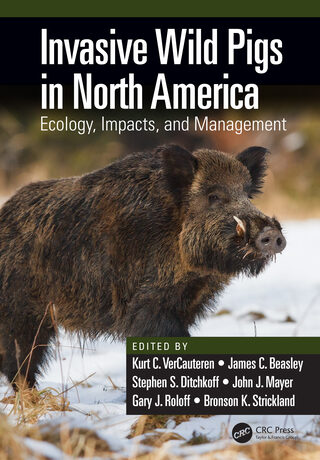
Get the definitive book on wild pig management at 20% off
Invasive Wild Pigs in North America: Ecology, Impacts, and Management (VerCauteren et al., eds., CRC Press, 2020) is the definitive book on wild pig biology, impacts, and control. Available from CRC Press — download the flyer (PDF) for a 20% discount code.